
ATIM recognizes four categories of interpreter:
- Conference Interpreter
- Community Interpreter
- Court Interpreter (also known as Legal Interpreter)
- Medical Interpreter (also known as Healthcare Interpreter)
Conference interpreting
Conference interpreting is the practice of facilitating accurate, impartial, and high-level spoken communication between speakers and audiences who do not share a common language, typically in multilingual meetings, conferences, and international events. Performed by highly trained language professionals, conference interpreting supports effective communication, informed participation, and decision-making in professional, institutional, and international contexts.
Conference interpreters work primarily in one or more interpreting modes, such as simultaneous or consecutive interpreting, and are accustomed to specialized subject matter and formal discourse. Conference interpreting occurs in a range of settings, including but not limited to:
- international and intergovernmental organizations
- government and public-sector meetings
- conferences, congresses, and symposia
- academic and scientific events
- corporate and industry meetings
- diplomatic, political, and high-level institutional settings
Community interpreting
Community interpreting is the practice of facilitating accurate, impartial, bidirectional spoken or signed communication between service providers and individuals who do not share a common language. Performed by trained language professionals, community interpreting enables equitable access to public, social, and community services that would otherwise be inaccessible due to language barriers.
Community interpreting occurs across a wide range of settings, including but not limited to:
- public institutions (e.g., local authorities, schools, universities, community centres)
- social services (e.g., employment assistance, refugee boards, support centres)
- business and industry services (e.g., housing, real estate, insurance, financial services)
- faith-based organizations (e.g., rituals and ceremonies)
Legal interpreting
Legal interpreting is the practice of facilitating accurate, impartial, and bidirectional spoken or signed communication between users of legal services and judicial or legal stakeholders who do not share a common language. Performed by trained language professionals, legal interpreting supports equal access to justice and due process for all parties.
Interpreters working in this setting are familiar with legal terminology and work in range of legal settings, including, but not limited to:
- police stations
- courtrooms and judicial proceedings
- lawyers’ offices
- correctional facilities
Healthcare interpreting
Healthcare interpreting is the practice of facilitating accurate, impartial, and bidirectional spoken or signed communication in health-care settings between patients, accompanying persons, and health-care providers who do not share a common language. Performed by trained language professionals, healthcare interpreting enhances patient safety, accessibility, equity, and quality of care, contributing to improved health outcomes.
Interpreters working in this setting are familiar with medical terminology and work in a range of healthcare settings, including but not limited to:
- hospitals
- clinics
- mental health programs
- long term care facilities
- public health
- home care
- oral health, etc.
Why certification matters in interpreting
Interpreting is not a regulated profession in Canada, which means certification is not legally required to work as an interpreter. In practice, however, the largest employers in Manitoba require it, and there is a clear trend toward greater professionalization of the field. Certification signals that you have acquired the skills, training, and ethical grounding needed to interpret professionally. It also increases credibility with employers and clients, supports quality and consistency of service, and contributes to public trust in interpreting services.
Working in Manitoba
Work is available in all four categories in Manitoba, but the amount of work will depend on your language combination, professional connections, and location. As the largest urban centres, Winnipeg and Brandon are where most interpreters live and work. Since the pandemic, however, many remote opportunities have also become available. That said, full-time employment as an interpreter is difficult to find in the province. You will likely need to combine interpreting income with another form of employment to make ends meet, and most opportunities that do exist will require specialized training.
Certification requirements vary depending on the type of interpreting you practise. If you are a conference interpreter, please refer to the section on conference interpreting. If you are interested in community, court, or medical interpreting, please refer to the corresponding heading, as these three categories have similar requirements.
Conference interpreting
Certification overview
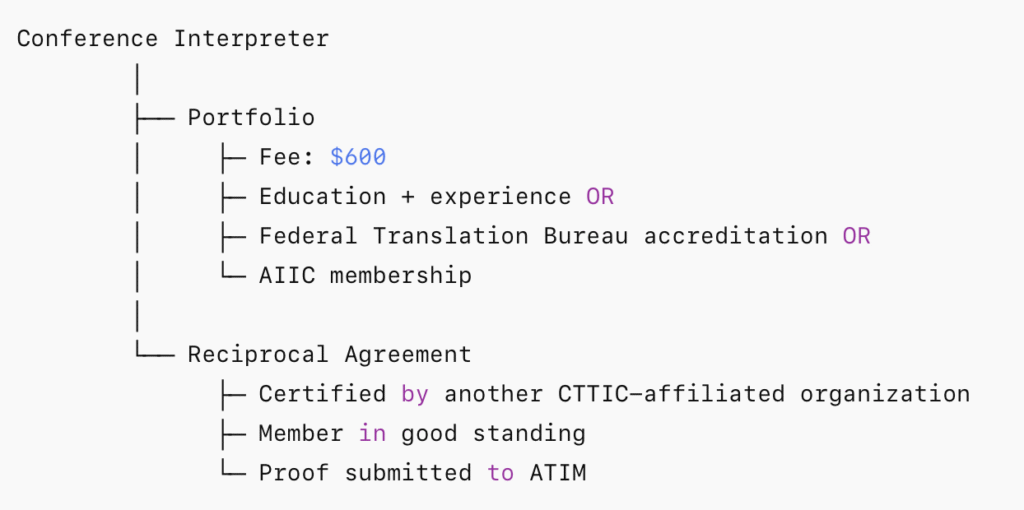
Conference interpreters may be certified through one of two pathways: portfolio or reciprocal agreement. The conference interpreter exam is not currently available.
Certification by portfolio is available to candidates who meet ATIM’s education and experience requirements, or who hold recognized credentials such as federal Translation Bureau accreditation or AIIC membership.
Certification by reciprocal agreement is available to conference interpreters who are already certified by another CTTIC-affiliated organization and are members in good standing.
Please refer to the detailed requirements below for full eligibility criteria.
Certification by portfolio
The fee for certification by portfolio is $600.
To qualify, you must meet one of the following sets of criteria:
Option 1
• Hold a master’s degree in conference interpreting from the University of Ottawa or Glendon College (York University), or from another training program deemed equivalent by a qualified conference interpreter trainer
• Have completed at least 100 documented conference assignments in the past two years in the relevant language combination, and
• Provide references from two certified conference interpreters working in the same language combination
Option 2
• Be accredited by the federal Translation Bureau in the relevant language combination
Option 3
• Hold AIIC (International Association of Conference Interpreters) membership in the relevant language combination
Certification by reciprocal agreement
To qualify through a reciprocal agreement, you must be certified as a conference interpreter by another CTTIC-affiliated organization, be a member in good standing of that organization, and provide proof of your membership to ATIM’s Director of Certification for approval.
Community, court and medical interpreting
Certification overview
Interpreters working in community, court, or medical settings in Manitoba must complete Shared Health’s Language Access Training Program in order to work in person. Prior training may be reviewed by Shared Health for recognition.
Certification in these settings is available through three pathways:
- Examination
- Portfolio
- Reciprocal agreement.
The examination pathway is the standard route to certification. The portfolio pathway is reserved for candidates for whom the examination is not an option. Reciprocal certification is available to interpreters already certified by another CTTIC-affiliated organization.
Please refer to the detailed requirements below for full eligibility criteria.
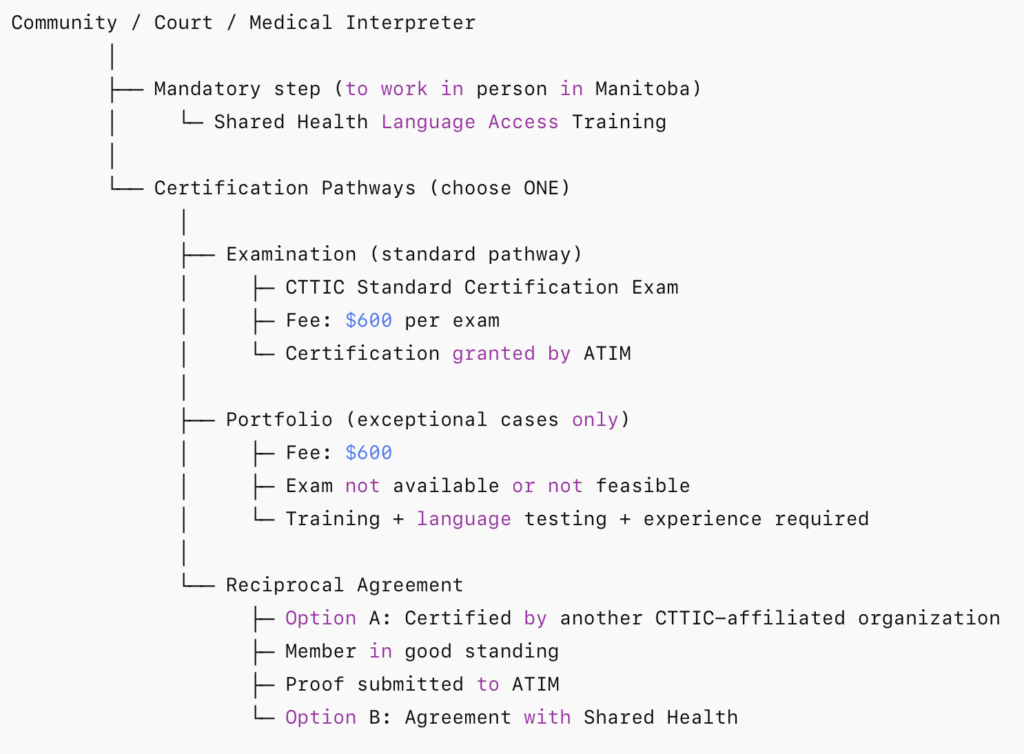
To work in person in any of these settings in Manitoba, you must complete Shared Health’s Language Access training program, which is offered regularly in required language combinations. Interpreters with prior training are still required to go through Shared Health. Depending on the program, Shared Health may recognize some or all of that training. ATIM also has an agreement with Shared Health under which Shared Health or WISLC interpreters who have acquired the requisite number of hours of experience may obtain ATIM certification automatically. Those interpreters should contact their employer for more details.
There are currently three pathways to certification for community, court and medical interpreters:
Certification by examination
Interpreters may obtain certification in their respective setting by passing CTTIC’s Standard Certification Examination in the corresponding category. CTTIC is the national federation of provincial translator and interpreter associations, including ATIM. While CTTIC administers the examinations, the authority to grant certification in Manitoba rests with ATIM.
The application fee is $600 per examination.
Certification by portfolio
The fee for certification by portfolio is $600.
This pathway is intended for candidates who are unable to pursue certification by examination, for example due to a language combination not currently tested, a documented inability to sit the exam, or other exceptional circumstances. The examination route remains the standard and preferred pathway, as it is more efficient and provides a direct assessment of interpreting skills.
To qualify, you must meet all the following requirements:
Training
Successful completion of one of the following programs:
• Shared Health / Westman Immigrant Services Language Centre (WISLC) Advanced Interpreter Training – Health Module (court interpreters must also complete the Legal Module after passing the Health Module); or
• Glendon College’s Graduate Diploma in General Interpreting; or
• Another training program deemed equivalent by a qualified interpreter trainer for the relevant setting, and/or in consultation with Shared Health’s Provincial Language Access Lead.
AND
Language and skills assessment
A valid ILSAT or CILISAT certificate in the relevant language combination, or a Language Line Academy Competence in Language Interpreting English to English certificate for languages for which no ILSAT or CILISAT exists, issued within the past five years, if applicable.
AND
Professional experience
Documented evidence of sufficient interpreting experience in the relevant setting within the past five years, as determined by Shared Health’s Provincial Language Access Lead or a qualified interpreter trainer, and in accordance with the most recent ISO standards for the setting.
Certification by reciprocal agreement
To qualify through a reciprocal agreement, you must be certified in the relevant setting by another CTTIC-affiliated organization, be a member in good standing of that organization, and provide proof of your membership to ATIM’s Director of Certification for approval.